The Dark Bailout
Saturday, November 15, 2008

too much government
President Bush Discusses Financial Markets and World Economy:
History has shown that the greater threat to economic prosperity is not too little government involvement in the market, it is too much government involvement in the market.
We saw this in the case of Fannie Mae and Freddie Mac. Because these firms were chartered by the United States Congress, many believed they were backed by the full faith and credit of the United States government. Investors put huge amounts of money into Fannie and Freddie, which they used to build up irresponsibly large portfolios of mortgage-backed securities. And when the housing market declined, these securities, of course, plummeted in value. It took a taxpayer-funded rescue to keep Fannie and Freddie from collapsing in a way that would have devastated the global financial system.
Friday, November 14, 2008
Peter Schiff Was Right
Peter Schiff Was Right
Gene Callahan:
Here we see a series of “esteemed” commentators, including Arthur Laffer and Ben Stein, basically laughing in Peter Schiff’s face even while he calls the coming downturn very accurately. The best moment may be Ben Stein insisting that Merrill Lynch was being “given away” at $76. (The stock today is at $14.)
Crisis Hits the Business Schools
"Crisis Hits the Business Schools" (Business Week):
Wherever they end up, those new applicants will find a B-school landscape in many ways transformed by the events of the past 18 months. While long-term curriculum shifts may take a few years, students can expect to encounter new classes, new case studies, and a new emphasis on risk. Much of this has already begun, with a growing number of business schools planning to add concentrations in risk management in coming years, ramping up the number of classes they offer and starting new risk management centers.
Thursday, November 13, 2008
Why Do People Fail to Understand?
"Why Do People Fail to Understand?" from Peter Boettke:
Economics is a fascinating discipline. Teaching and research in economics is a "calling" I would argue. We want to continually engage the profession and raise the level of discourse. Blogs can help us "think aloud", but ultimately I think that exercise needs to be constrained against professional activities. Blogs, in short, cannot be seen as a substitute for more traditional publishing activity.
I would advice graduate students .... to focus their energies on learning the discipline inside and out, learning how to teach the subject to students ...., learning how to research, and learning how to write for professional audiences as well as the general public. Don't worry about being clever, focus instead on being clear. Don't worry about careerism, focus instead on tracking truth and being correct. If you have questions, ask them. If you have ideas, excellent but remember that "thinking without publishing is daydreaming." And who really want to hear your dreams beyond your friends, family and perhaps therapist?!
What proposals would you have to improve the level of economic discourse that we see on the blogosphere?
Monday, November 10, 2008
Environmentalism Is Racism
"Environmentalism Is Racism" by Eric Englund:
.... today’s environmentalists .... hate private property, they hate human liberty, they hate prosperity, they hate modern-day industry, and they hate the free market. They will always choose beavers, trees, and rock formations over people. Environmentalists are using .... legal constraints to slowly choke off capitalism and supplant it with socialism .... When you sum all of this up, Greenies simply detest the human race. Accordingly, environmentalism is the deepest and broadest form of racism known to mankind.
What You Should Know About Inflation
"What You Should Know About Inflation" by Henry Hazlitt:
Inflation, to sum up, is the increase in the volume of money and bank credit in relation to the volume of goods. It is harmful because it depreciates the value of the monetary unit, raises everybody's cost of living, imposes what is in effect a tax on the poorest (without exemptions) at as high a rate as the tax on the richest, wipes out the value of past savings, discourages future savings, redistributes wealth and income wantonly, encourages and rewards speculation and gambling at the expense of thrift and work, undermines confidence in the justice of a free enterprise system, and corrupts public and private morals.
Inflation, always and everywhere, is primarily caused by an increase in the supply of money and credit. In fact, inflation is the increase in the supply of money and credit.
.... inflation must always end in a crisis and a slump, and that worse than the slump itself may be the public delusion that the slump has been caused, not by the previous inflation, but by the inherent defects of "capitalism."
Sunday, November 9, 2008
Improve Economic Performance
"What Steps Should the New Administration Take to Improve Economic Performance?" in the Economist's Views blog, with the contribution of several economist to the New York Times.
Krugman’s prize (2)
Following the post "Krugman’s prize", the Robert Samuelson article on Real Clear Politics "Poor Aren't Poor Because Rich Are Rich":
By and large, the poor aren't poor because the rich are rich. They're usually poor for their own reasons: family breakdown, low skills, destructive personal habits and plain bad luck.
The presumption implicit in the criticism of growing economic inequality is that society's income is a given and, if the rich have less, others will have more.
The larger truth is that much of the income of the rich and well-to-do comes from what they do. If they stop doing it, then the income and wealth vanish. No one gets it. It can't be redistributed because it doesn't exist. Everyone's poorer.
Change you can believe in (2)
"Obama Appoints Foul-Mouthed Freddie Mac Crony Chief of Staff" (OpenMarket.org):
"Forget the Honeymoon" of Justin Raimondo of AntiWar.com:
Obama has appointed as his chief of staff Rahm Emanuel, a former director of the failed government-backed mortgage giant Freddie Mac, which had to be bailed out by taxpayers. It’s perhaps not surprising, given that Obama was the second-largest recipient of campaign contributions from Fannie Mae and Freddie Mac, the government-sponsored mortgage giants that helped spawn the mortgage meltdown and financial crisis.
"Forget the Honeymoon" of Justin Raimondo of AntiWar.com:
He's mean, he's ultra-partisan, and he's a fully-paid up member in good standing of the War Party: ..."What about Rahm Emanuel [for Vice President], the most powerful voice in the House of Representatives that agrees with Hillary Clinton on foreign affairs? He's a hawk. And although he's a rootin' tootin' liberal on domestic affairs, he is a hawk on foreign affairs .... here you have the hawkish side of the Democratic Party.

Change you can believe in
"Former Bear Stearns Risk Manager Turns Up at Fed" (The New York Times):
The former chief risk officer at investment bank Bear Stearns , which nearly collapsed in March, is now a senior official of the Federal Reserve division that supervises U.S. banks.
The Relevance of the Great Depression
"The Relevance of the Great Depression" by David Friedman:
It could happen again. One can imagine a future in which President Obama, supported by Democratic majorities in both houses, engages in massive interventions in the economy following the massive interventions already under way and the result is a serious economic downturn prolonged for years, perhaps for two terms. If that happens many people--most obviously, the same people who insist that the collapse of Fannie Mae and the associated difficulties are the fault of laissez-faire and deregulation--will conclude that only massive intervention preserved us from a still worse outcome.
Saturday, November 8, 2008
Now, I’ve noticed a tendency for politics to get rather silly
Via The Beacon, following this article on the WSJ, "Plants Have Rights Too!":
Here's the PDF: "The Dignity of Living Beings with Regard to Plants"
For years, Swiss scientists have blithely created genetically modified rice, corn and apples. But did they ever stop to consider just how humiliating such experiments may be to plants?
That’s a question they must now ask. Last spring, this small Alpine nation began mandating that geneticists conduct their research without trampling on a plant’s dignity.
Here's the PDF: "The Dignity of Living Beings with Regard to Plants"
a sad reflection of the hyperspecialization among intellectuals
"Egalitarianism as a Revolt Against Nature" by Murray Rothbard:
I think it manifestly true that very few of even the most dedicated economic technicians began their interest in economics because they were fascinated by cost curves, indifference classes, and the rest of the paraphernalia of modern economic theory.
.... they became interested in economics because they were interested in social and political problems and because they realized that the really hard political problems cannot be solved without an understanding of economics.
Infortunately, what usually happens to these people is that .... they learn .... that prestige, rewards, and brownie points are garnered not by pondering the larger problems but by sticking to one's narrow last and becoming a leading expert on a picayune technical problem.
Economic and Climate Models
"Economic and Climate Models" by Robert P. Murphy:
The "rigorous," peer-reviewed Keynesian economic models reached the zenith of their professional success in the 1950s and 1960s, and yet, in retrospect, many economists would now admit that they were fundamentally flawed and provided horrible policy recommendations. Despite the obvious differences between the disciplines, this sorry episode from the field of economics should counsel caution before we hand over even more power to the politicians due to the results of mainstream climate models.
Let me be clear: I am not saying that the climate models are demonstrably wrong .... To go back to economics, it is not as if Paul Samuelson made a mistake in his arithmetic and that's why the United States experienced stagflation .... But if you suspected that perhaps the very approach of the model was flawed, you wouldn't expect Paul Samuelson — the very person responsible for the mainstream approach — to engineer a paradigm shift.
It is true that science must start somewhere, and a bad model is better than no model. But this truism does not mean governments should expand their powers whenever the "best guess" says it would be a good idea. A wise student of history should also be able to say, "We really don't understand this very well yet."
Thursday, November 6, 2008
Open letter
An Open Letter to my Friends on the Left" by Stephen Horwitz:
Consider instead that the problems of this mess were caused by the very kinds of government regulation that you now propose. Consider instead that effects of the profit motive that you decry depend upon the incentives that institutions, regulations, and policies create, which in this case led profit-seekers to do great damage. Consider instead that the regulations that may have been the cause were supported by, as they have often been throughout US history, the very firms being regulated, mostly because they worked to said firms' benefit, even as they screwed the rest of us. Consider all of this as you ask for more of the same in the name of fixing the problem. And finally, consider why you would ever imagine that those with wealth and power wouldn't rig a new regulatory process in their favor.
Wednesday, November 5, 2008
Michael Crichton on Environmentalism
Michael Crichton (1942-2008), lecture at the Commonwealth Club on September 15, 2003 (full PDF at the Heartland Institute):
Michael Crichton on Environmentalism as a Religion
Michael Crichton on Global Warming, Part 1 of 3
Part 2 | Part 3
Today, one of the most powerful religions in the Western World is environmentalism. Environmentalism seems to be the religion of choice for urban atheists. Why do I say it's a religion? Well, just look at the beliefs. If you look carefully, you see that environmentalism is in fact a perfect 21st century remapping of traditional Judeo-Christian beliefs and myths.
Michael Crichton on Environmentalism as a Religion
Michael Crichton on Global Warming, Part 1 of 3
Part 2 | Part 3
the value of a filibuster-proof Senate
"Senate Democrats don't need 60 seats to reach their magic number" by Bruce Reed (Slate)
But reaching 60 seats won't suspend the laws of political gravity for Senate Democrats, nor will keeping Democrats in the 50s do much to ease Senate Republicans' pain.
Regulation and laissez-faire
"Capitalism and the Financial Crisis" by Walter Williams:
It is incorrect to say that laissez-faire or free markets are unregulated. There is ruthless regulation, but it's not by government ....
When businesses make unwise decisions that lead to bankruptcy, their assets are sold off to someone else who might be able to put them to wiser use. Government bailouts give businesses a reprieve that the market wouldn't give them.
Jack Welch on Obama
"Obama Win Is Management Lesson to All: Welch" (CNBC):
"If you look at management skills as being execution, as one of the real issues, this guy demonstrated without question the best execution I've ever seen in a political campaign," Welch said.
"He came from a basement startup to build an organization that was flawless- demonstrated in the culmination in Chicago last night with one of the most impressive rallies, or celebrations, one could ever see. This is a manager. This is a real manager."
Obama’s first test
"Russia to station missiles near Poland" (Reuters)
[AA] Needless to say, this event will both test the president's resolve to lead a less interventionist American foreign policy, and strain his political capital within America and all over the world - whatever decision he takes. The vagueness of his campaign propositions was - electorally - an optimum situation. Now Obama cannot avoid upsetting those who'd like a more sheepish stance, as well as the ones who'd prefer a more muscled reaction. And the worst case scenario is making Russia the villain of the situation. Obama cannot not act. Prepare for cold war.
[AA] Needless to say, this event will both test the president's resolve to lead a less interventionist American foreign policy, and strain his political capital within America and all over the world - whatever decision he takes. The vagueness of his campaign propositions was - electorally - an optimum situation. Now Obama cannot avoid upsetting those who'd like a more sheepish stance, as well as the ones who'd prefer a more muscled reaction. And the worst case scenario is making Russia the villain of the situation. Obama cannot not act. Prepare for cold war.
The Myth that Laissez Faire Is Responsible for Our Financial Crisis
"The Myth that Laissez Faire Is Responsible for Our Financial Crisis" by George Reisman:
.... the politico-economic system of the United States today is so far removed from laissez-faire capitalism that it is closer to the system of a police state than to laissez-faire capitalism. The ability of the media to ignore all of the massive government interference that exists today and to characterize our present economic system as one of laissez-faire and economic freedom marks it as, if not profoundly dishonest, then as nothing less than delusional.
It seems that so long as anyone manages to move or even breathe without being under the control of the government, laissez faire allegedly continues to exist, which serves to make necessary yet still more government controls.
property rights
Harold Demsetz:
The allegation is that even perfectly competetive markets fail to achieve efficiency. But, this reasoning generally fails to take account of the fact that the provision of a market (for the side effect) is itself a valuable and costly service.
In asking the implications of the nonexistence of some markets, we seem to have fogotten the cost of providing market services or their government equivalent.
Tuesday, November 4, 2008
The state is the great fictitious entity by which everyone seeks to live at the expense of everyone else
Massachusetts Question 1: Repeal State Income Tax has failed to pass the popular vote.
Note: the title is a quote by Frédéric Bastiat.
This measure would cut the state personal income tax rate in half for 2009 and eliminate the state personal income tax starting in 2010. A similar measure was on the ballot in 2002 but failed.
Note: the title is a quote by Frédéric Bastiat.
The Worst of All Worlds
"The Worst of All Worlds by Bjørn Lomborg:
Have you noticed how environmental campaigners almost inevitably say that not only is global warming happening and bad, but also that what we are seeing is even worse than expected?
.... one can argue that if the models constantly get something wrong, it is probably because the models are wrong. And if we cannot trust our models, we cannot know what policy action to take if we want to make a difference.
Peter Schiff: Economic Impact Of Obama Victory
11/3/2008 -Peter Schiff On Squawk Box:Economic Impact Of Obama Victory

Neutrality of money
From the wikipedia:
Paul Krugman:
Ludwig Von Mises (The Non-Neutrality of Money, 1934):
In economics, neutrality of money is the idea that a change in the stock of money affects only nominal variables in the economy such as prices, wages and exchange rates, having no effect on real variables like GDP, employment, and consumption.
Paul Krugman:
The proposition known as the neutrality of money - the assertion that other things equal the price level is proportional to the money supply - is central to every monetary theory I know of.
Ludwig Von Mises (The Non-Neutrality of Money, 1934):
.... the essence of the fallacy of money's neutrality [is] that .... changes in purchasing power [are] brought about simultaneously in the whole market and that they [affect] all commodities to the same extent ....
To simplify and to shorten our analysis let us look at the case of inflation only. The additional quantity of money does not find its way at first into the pockets of all individuals; not every individual of those benefited first gets the same amount and not every individual reacts to the same additional quantity in the same way .... The result is that there is in the economic system a new dispersion of wealth and income and in this new social order the wants of individuals are satisfied to different relative degrees, than formerly. Prices in this new order can not simply be a multiple of the previous prices.
.... I wish to emphasize that in a living and changing world, in a world of action, there is no room left for a neutral money. Money is non-neutral or it does not exist.
Monday, November 3, 2008
Sickness
Glenn Reynolds:
SO PEOPLE ON THE LEFT AND RIGHT ARE BOTH worried sick about the election. Both seem more worried about the other guys controlling the White House than anxious to win themselves. (Some are very worried). They're right to be worried, of course, at least to a degree. The Presidency is an office of great power.
On the other hand, if the federal government were properly limited to its constitutional powers, there would be much less to fear, and elections would be less stressful for all concerned. Just a thought.
Dr. Doom
"Nouriel Roubini: I fear the worst is yet to come" (Times Online):
- "The Rising Risk of a Systemic Financial Meltdown: The Twelve Steps to Financial Disaster"
- "Can the Fed and Policy Makers Avoid a Systemic Financial Meltdown? Most Likely Not."
- "Martin Wolf of the Financial Times on my "12 Steps to Financial Disaster""
20081022 Roubini CNBC 1
While the economic sun was shining, most other economists scoffed at Roubini and his predictions of imminent disaster. They dismissed his warnings that the sub-prime mortgage disaster would trigger a financial meltdown. They could not quite believe his view that the US mortgage giants Fannie Mae and Freddie Mac would collapse, and that the investment banks would be crushed as the world headed for a long recession.
Yet all these predictions and more came true. Few are laughing now.
- "The Rising Risk of a Systemic Financial Meltdown: The Twelve Steps to Financial Disaster"
- "Can the Fed and Policy Makers Avoid a Systemic Financial Meltdown? Most Likely Not."
- "Martin Wolf of the Financial Times on my "12 Steps to Financial Disaster""
20081022 Roubini CNBC 1
Accounting Basics & the Financial Crisis
Something the 1st-year people might find useful:
"Accounting Basics & the Financial Crisis" by Bob Murphy
"Accounting Basics & the Financial Crisis" by Bob Murphy
Keynes’ wet dream coming true
Stiglitz calls for Global Currency
Professor Joseph Stiglitz says that a "global reserve currency" taking the place of the dollar would ease the financial crisis.
Sunday, November 2, 2008
it is through exchange that difference becomes a blessing, not a curse
From the Quote of the Day of the Austrian Economists:
Steven Horwitz, "Comparative Advantage", in the Fraser Institute's website:
A primordial instinct going back to humanity's tribal past makes us see difference as a threat. That instinct is massively dysfunctional in an age in which our several destinies are interlinked. Oddly enough, it is the market -- the least overtly spiritual of concepts -- that delivers a profoundly spiritual message: that it is through exchange that difference becomes a blessing, not a curse. When difference leads to war, both sides lose. When it leads to mutual enrichment, both sides gain.
Steven Horwitz, "Comparative Advantage", in the Fraser Institute's website:
.... once one understands the concept of comparative advantage, one can see how economics helps us to reveal perhaps the most important benefit of diversity: when people are free to produce by comparative advantage and then trade what they produce, human diversity becomes a source of both increased material well-being and expanded peaceful human cooperation. The more freedom we give to people to engage in the market process, the more that diversity and difference really do become humanity’s blessing and not its curse.
Orwell, or Why We Need to Call a Pig a Pig
"Why We Need to Call a Pig a Pig" (Newsweek):
Since its publication in 1945, "Animal Farm" has sold more than 10 million copies worldwide, and become a standard text for schoolchildren, along with Orwell's other dystopian vision of the future, "1984." But it is the writer's essays on the importance of clear language and independent thought that make him relevant. Consider this, from "Politics and the English Language": "The word Fascism has now no meaning except insofar as it signifies 'something not desirable.' The words democracy, socialism, freedom, patriotic, realistic, justice, have each of them several different meanings which cannot be reconciled with one another … Words of this kind are often used in a consciously dishonest way."
Does the free market corrode moral character?
Does the free market corrode moral character?, a discussion in the John Templeton Foundation website.
The answer of Ben Asa Rast:
The answer of Ben Asa Rast:
Perhaps the best way to answer this question is to ask another: does an un-free market improve moral character? Or, to phrase it differently, can coercion improve moral character? I think the answer is found in history. Rare is the man who can exercise such power over others without eventually being corrupted by it. As C.S. Lewis said: Aristotle was right; some men are fit to be only slaves; but I oppose slavery because I do not believe any man is fit to be a master.
Saturday, November 1, 2008
a crisis of distorted markets
"Franklin Delano Bush" by Don Boudreaux:
Furthermore, via O Insurgente, the editorial of the Washington Post(via Cafe Hayek):
History will forget Bush's interventions just as it has forgotten Hoover's - as it has forgotten that Hoover signed the largest tariff hike in U.S. history; as it has forgotten that Hoover tried to create jobs by deporting hundreds of thousands of Mexicans; as it has forgotten that Hoover signed the Emergency Relief and Construction Act, the Federal Home Loan Bank Act, and created the Reconstruction Finance Corporation; as it has forgotten that, with the Revenue Act of 1932, Hoover raised the top marginal tax rate on personal incomes from 25 percent to 63 percent (in addition to raising the corporate-tax rate).
History will repeat itself, blaming capitalism for a problem caused and intensified by government interventions.
Furthermore, via O Insurgente, the editorial of the Washington Post(via Cafe Hayek):
Is this the end of American capitalism? As financial panic spread across the globe and governments scrambled to contain the damage, reality seemed to announce the doom of U.S.-style free markets and President Bush’s ideology. But this is wrong in two ways. The deregulation of U.S. financial markets did not reflect only the narrow ideology of a particular party or administration. And the problem with the U.S. economy, more than lack of regulation, has been government’s failure to control systemic risks that government itself helped to create. We are not witnessing a crisis of the free market but a crisis of distorted markets.
Wikipedia and Economics
Interview with Jimmy Wales, founder of Wikipedia: "Wikipedia and Beyond" (Reason Magazine):
.... Wales has offered a more erudite account of the site's origins and purpose. In 1945, in his famous essay "The Use of Knowledge in Society," the libertarian economist F.A. Hayek argued that market mechanisms serve "to share and synchronize local and personal knowledge, allowing society's members to achieve diverse, complicated ends through a principle of spontaneous self-organization." .... "One can't understand my ideas about Wikipedia without understanding Hayek." Long before socialism crumbled, Hayek saw the perils of centralization. When information is dispersed (as it always is), decisions are best left to those with the most local knowledge ....
Friday, October 31, 2008
Is Barack Obama really a socialist?
Donald J. Boudreaux:
Thom Lambert:
National Journal:
No. At least not in the classic sense of the term. "Socialism" originally meant government ownership of the major means of production and finance, such as land, coal mines, steel mills, automobile factories, and banks.
Thom Lambert:
If the fact that Sen. McCain voted “with the President” 90% of the time means a McCain administration would be “more of the same,” does the fact that Sen. Obama voted with Congress’s sole socialist 92% of the time mean that an Obama administration would be socialist?
.... how frequently Sen. Obama voted with the nation’s one socialist senator, Vermont’s Bernie Sanders [?] .... “In Senate Roll Call votes in the first session of this Congress, where the two voted, Obama voted with Sanders 92% of the time.”
National Journal:
Sen. Barack Obama, D-Ill., was the most liberal senator in 2007, according to National Journal's 27th annual vote ratings. The insurgent presidential candidate shifted further to the left last year in the run-up to the primaries, after ranking as the 16th- and 10th-most-liberal during his first two years in the Senate.
judges who decide cases based on who you are, rather than on the facts and the law
"Obama and the Law" by Thomas Sowell:
Senator Obama has stated very clearly what kinds of Supreme Court justices he wants-- those with "the empathy to understand what it's like to be poor, or African-American, or gay, or disabled, or old."
Like so many things that Obama says, it may sound nice if you don't stop and think-- and chilling if you do stop and think. Do we really want judges who decide cases based on who you are, rather than on the facts and the law? ....
Didn't we spend decades in America, and centuries in Western civilization, trying to get away from the idea that who you are determines what your legal rights are? ....
Don’t Just Do Something. Stand There.
"Don't Just Do Something. Stand There." by Russel Roberts:
Today, President George W. Bush plays the role of Hoover, the so-called free market ideologue who is trying anything to avert disaster. He signs a $700 billion bill putting Treasury in charge of buying troubled assets. A week later, the money is used to partially nationalize the banks. Some companies, like Bear Stearns, are bailed out. Others, like Lehman Brothers, are not. Some companies are sold. Some are allowed to fail. There is no plan, no rules, nothing to count on.
It's just like the New Deal: a massive accumulation of power in Washington justified by the need to do something. There is every reason to think this trend will accelerate regardless of whether Barack Obama or John McCain wins the election.
Thursday, October 30, 2008
The 4 Ways to Spend Money (1)
- When a man spends his own money to buy something for himself, he is very careful about how much he spends and how he spends it.
- When a man spends his own money to buy something for someone else, he is still very careful about how much he spends, but somewhat less what he spends it on.
- When a man spends someone else's money to buy something for himself, he is very careful about what he buys, but doesn't care at all how much he spends.
- And when a man spends someone else's money on someone else, he does't care how much he spends or what he spends it on. And that's government for you.
The 4 Ways to Spend Money by Milton Friedman
Intellectuals and Socialism (4)
"Why Intellectuals Still Support Socialism" by Peter G. Klein:
.... there are many benefits, for academics, to living in a highly interventionist society. It should be no wonder, then, that academics tend to support those interventions. Economists, in particular, play active roles as government advisers, creating and sustaining the welfare state that now surrounds us. Naturally, when government funds their research, economists in applied fields such as agricultural economics and monetary economics are unlikely to call for serious regulatory reform in their specialty areas.
Intellectuals and Socialism (3)
"Natural Elites, Intellectuals, and the State" by Hans-Hermann Hoppe:
There are almost no economists, philosophers, historians, or social theorists of rank employed privately by members of the natural elite. And those few of the old elite who remain and who might have purchased their services can no longer afford intellectuals financially. Instead, intellectuals are now typically public employees, even if they work for nominally private institutions or foundations. Almost completely protected from the vagaries of consumer demand ("tenured"), their number has dramatically increased and their compensation is on average far above their genuine market value.
Intellectuals and Socialism (2)
"The Intellectuals and Socialism" by Friedrich Hayek:
In fact, it is necessary to recognize that, on the whole, the typical intellectual is today more likely to be a socialist the more he is guided by good will and intelligence, and that on the plane of purely intellectual argument he will generally be able to make out a better case than the majority of his opponents within his class.
The socialist will, of course, see in this merely a proof that the more intelligent person is today bound to become a socialist .... is therefore probably the fact, not that the more intelligent people are generally socialists, but that a much higher proportion of socialists among the best minds devote themselves to those intellectual pursuits which in modern society give them a decisive influence on public opinion.
Intellectuals and Socialism (1)
Ludwig von Mises, The Anti-Capitalist Mentality:
The people of the United States are more prosperous than the inhabitants of all other countries because their government embarked later than the governments in other parts of the world upon the policy of obstructing business. Nonetheless, many people, and especially intellectuals, passionately loathe capitalism.
They—the professors, the representatives of science, and the writers, the representatives of literature— .... must stand for planning, the welfare state, socialism, and they must support all measures designed to curb the greed of management and to prevent it from abusing its economic power.
Intellectuals and Socialism (0)
"Why Socialism?" by Albert Einstein:
The economic anarchy of capitalist society as it exists today is, in my opinion, the real source of the evil.
I am convinced there is only one way to eliminate these grave evils, namely through the establishment of a socialist economy, accompanied by an educational system which would be oriented toward social goals. In such an economy, the means of production are owned by society itself and are utilized in a planned fashion. A planned economy, which adjusts production to the needs of the community, would distribute the work to be done among all those able to work and would guarantee a livelihood to every man, woman, and child. The education of the individual, in addition to promoting his own innate abilities, would attempt to develop in him a sense of responsibility for his fellow-men in place of the glorification of power and success in our present society.
FDR’s policies prolonged Depression (3)
"FDR Is Everywhere in Sight" by Anthony Gregory:
It is funny that FDR is so universally beloved on left and right. He imposed counterproductive economic fascism, destroyed food while people starved, imposed gun control and drug control at the federal level, created Fannie Mae (which has continued to cause economic troubles), drafted plans to round up rightwing and leftwing activists without due process, conscripted ten million Americans into the military, waged total war on civilians, brought nuclear weaponry into the world, stuck tens of thousands of U.S. citizens into concentration camps, set up a censorship office, palled around with Stalin, turned away exiled Jews back to Nazi control, was all around deceitful in foreign affairs, and did not actually bring America out of the Depression, in terms of economic well-being for the American people.
Monday, October 27, 2008
Quote of the day
It is amazing that people who think we cannot afford to pay for doctors, hospitals, and medication somehow think that we can afford to pay for doctors, hospitals, medication and a government bureaucracy to administer it.
Thomas Sowell
The Age of Prosperity Is Over
"The Age of Prosperity Is Over" by Arthur B. Laffer:
This administration and Congress will be remembered like Herbert Hoover.
.... the government doesn't create anything; it just redistributes. Whenever the government bails someone out of trouble, they always put someone into trouble, plus of course a toll for the troll. Every $100 billion in bailout requires at least $130 billion in taxes, where the $30 billion extra is the cost of getting government involved.
If you don't believe me, just watch how Congress and Barney Frank run the banks. If you thought they did a bad job running the post office, Amtrak, Fannie Mae, Freddie Mac and the military, just wait till you see what they'll do with Wall Street.
These issues aren't Republican or Democrat, left or right, liberal or conservative. They are simply economics, and wish as you might, bad economics will sink any economy no matter how much they believe this time things are different. They aren't.
Saturday, October 25, 2008
soon afterwards bears and Man evolved into existence
"Less Ice In Arctic Ocean 6000-7000 Years Ago" (Science Daily):
ScienceDaily (Oct. 20, 2008) — Recent mapping of a number of raised beach ridges on the north coast of Greenland suggests that the ice cover in the Arctic Ocean was greatly reduced some 6000-7000 years ago. The Arctic Ocean may have been periodically ice free.
something far worse
Helicopter Ben Earns His Wings by Peter Schiff (21 de Setembro de 2007):
Those who believe the Fed should reduce interest rates to ward off a recession or stabilize home prices simply do not understand the situation. More credit is not the solution: it is part of the problem. Our economy is on the brink of disaster because irresponsible Fed policy encouraged Americans to borrow and spend too much and created an unprecedented national real estate bubble. The last thing the Fed should do is entice Americans to borrow more money they cannot repay, buy more imported products they cannot afford, and attempt to blow more air into the deflating real estate bubble.
Bernanke’s attempt to circumvent the free market forces that are bringing on a long overdo recession (which is necessary to purge our economy of unsustainable imbalances) will lead to an even greater disaster. Make no mistake about it; had the Fed done nothing, or raised rates as I would have preferred, the economy would have clearly tipped toward a severe recession. However, by “coming to the rescue” with rate cuts, the Fed assures us that we will experience something far worse.
The Standard of Living Bubble
"The Standard of Living Bubble (And Why It’s About to Go Pop!)" of Karen de Costner:
The central planners in Washington, along with the Federal Reserve, planned and fueled an unsustainable standard of living across the country, from the neighborhoods of McMansions to the ghettos. The impending bust will affect us all, regardless of whether or not we partook in any of those easy-credit orgies sponsored by our leaders in Washington.
Thursday, October 23, 2008
Why Paul Krugman deserved the Nobel Prize.
Not as Bad as You Thought by Arnold Kling, in Reason Magazine:
Paul Krugman received a Nobel Prize for his contributions to international trade theory. Even for those of us who disagree with his political views and see little value in his recent work as a columnist, this award brings neither surprise nor disappointment.
Wednesday, October 22, 2008
The candidate’s Energy and Environmental Plans
"Comparison of Obama and McCain’s Energy and Environmental Plans" (Institute for Energy Research)
Financial Crisis and Spain
"Financial Crisis and Recession" by Jesus Huerta de Soto:
The case of Spain is paradigmatic. The Spanish economy underwent an economic boom that was due, in part, to real causes (liberalizing structural reforms which originated with José María Aznar's administration). Nevertheless, the boom was also largely fueled by an artificial expansion of money and credit, which grew at a rate nearly three times the corresponding rates in France and Germany.
Spanish economic agents essentially interpreted the decrease in interest rates which resulted from the convergence process in the easy-money terms traditional in Spain: a greater availability of easy money and mass requests for loans from Spanish banks (mainly to finance real-estate speculation), loans which these banks have granted by creating the money ex nihilo while European central bankers looked on unperturbed. When faced with the rise in prices, the European Central Bank has remained faithful to its mandate and has decided not to lower interest rates despite the difficulties of those members of the Monetary Union which, like Spain, are now discovering that much of their investment in real estate was in error and are heading for a lengthy and painful reorganization of their real economy.
Stochastic calculus p-rn
"Economists with Pseudo-Knowledge" by Arnold Kling:
[ sorry about the editing, IESE's filter would ban this site ]
I have always thought that the issue of the relationship between financial markets and the "real economy" was really deep. I thought that it was a critical part of macroeconomic theory that was poorly developed. But the economics profession for the past thirty years instead focused on producing stochastic calculus p-rn to satisfy young men's urge for mathematical m-st-rb-t--n.
Economists ought to admit that we do not know much about what is going on today. Neither do the Fed Chairman and the Treasury Secretary. Of course, the market demand is for "strong" leaders and for "strong" economists, who can fool the public into believing that they have great knowledge. The ones who do this best are those who have fooled themselves.
[ sorry about the editing, IESE's filter would ban this site ]
WSJ: Get Rid of the Performance Review!
"Get Rid of the Performance Review!" by Samuel A. Culbert in the Wall Street Journal:
I believe it's immoral to maintain the facade that annual pay and performance reviews lead to corporate improvement, when it's clear they lead to more bogus activities than valid ones. Instead of energizing individuals, they are dispiriting and create cynicism. Instead of stimulating corporate effectiveness, they lead to just-in-case and cover-your-behind activities that reduce the amount of time that could be put to productive use. Instead of promoting directness, honesty and candor, they stimulate inauthentic conversations in which people cast self-interested pursuits as essential company activities.
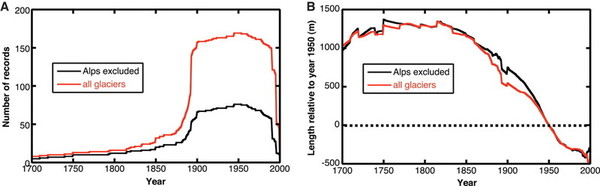
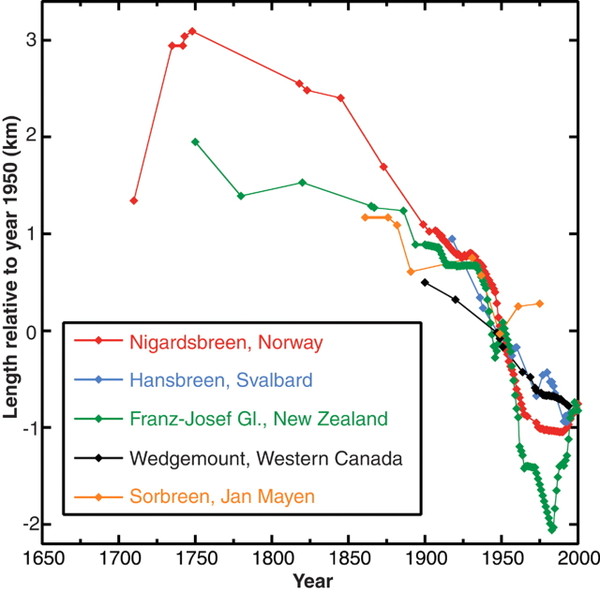
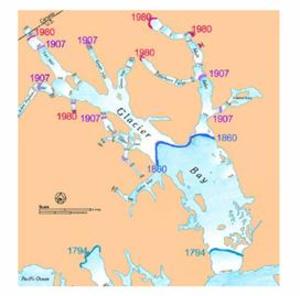
glaciers on retreating trend for decades
One of the panicky claims of global warming catastrophists is that some sort of "unprecedented" melting and retreat of glaciers is occurring tied to anthropogenic global warming. I have seen anecdotal evidence for a while that this melting of glaciers began long before the 1950-present "anthropogenic" era, but I had not seen anything systematic on the topic until I discovered this study by L. Oerlemans et al as published in Science in 2005.
I, Pencil (2)
"I, Pencil: My Family Tree as told to Leonard E. Read":
I, Pencil, am a complex combination of miracles: a tree, zinc, copper, graphite, and so on. But to these miracles which manifest themselves in Nature an even more extraordinary miracle has been added: the configuration of creative human energies—millions of tiny know-hows configurating naturally and spontaneously in response to human necessity and desire and in the absence of any human master-minding! Since only God can make a tree, I insist that only God could make me. Man can no more direct these millions of know-hows to bring me into being than he can put molecules together to create a tree.
Argentinian welfare system bankrupt; government plunders private savings
Argentina Makes Grab for Pensions Amid Crisis (Wall Street Journal):
José Piñera, a former Chilean cabinet minister who pioneered the privatized pension system and has served as a consultant to many other countries that have implemented it, called the nationalization proposal "just another step in Argentina's 100-year 'road to underdevelopment.'"
Taxation inequality

Both Candidates' Tax Plans Will Reduce Millions of Taxpayers' Liability to Zero (or Less) (Tax Foundation):
Over the past two decades, lawmakers have increasingly turned to the tax system rather than direct spending programs to funnel money to targeted groups of Americans, furthering some social or political goal. As a result, millions of Americans have been effectively removed from the income tax payment system while the tax code has been made more complicated to comply with and more difficult to administer. The tax plans of both the presidential candidates would exacerbate this situation greatly.
It is time for a serious public discussion of whether it is desirable to have so many Americans disconnected from the cost of government and what the consequences are of using the tax system as a vehicle for social policy.
Tuesday, October 21, 2008
FDR's policies prolonged Depression (2)
"How FDR Made the Depression Worse by Robert Higgs:
.... the grand promise of an end to the suffering was never fulfilled. As the state sector drained the private sector, controlling it in alarming detail, the economy continued to wallow in depression. The combined impact of Herbert Hoover's and Roosevelt's interventions meant that the market was never allowed to correct itself. Far from having gotten us out of the Depression, FDR prolonged and deepened it, and brought unnecessary suffering to millions.
FDR's policies prolonged Depression
UCLA Newsroom: FDR's policies prolonged Depression by 7 years, UCLA economists calculate:
After scrutinizing Roosevelt's record for four years, Harold L. Cole and Lee E. Ohanian conclude in a new study that New Deal policies signed into law 71 years ago thwarted economic recovery for seven long years.
"This is exciting and valuable research," said Robert E. Lucas Jr., the 1995 Nobel Laureate in economics, and the John Dewey Distinguished Service Professor of Economics at the University of Chicago. "The prevention and cure of depressions is a central mission of macroeconomics, and if we can't understand what happened in the 1930s, how can we be sure it won't happen again?"
Paul Krugman, Portugal e o TGV
An interesting article about Paul Krugman, Portugal and the high speed train (in Portuguese):
A pergunta que se segue, claro, é: qual é o efeito da ligação de TGV entre Madrid e Lisboa? Se estivermos num regime de custos de transporte baixos, o TGV contribuirá para o declínio demográfico do centro populacional com menor escala, isto é, Lisboa. Se passarmos para o regime de custos de transportes negligenciáveis, o TGV vai dispersar a população de Madrid e de Lisboa ao longo da linha entre Lisboa e Madrid. Eu aposto que não estaremos no regime de preços negligenciáveis, mas sim no regime de preços baixos. Os portugueses, ao subsidiarem o TGV, vão subsidiar o declínio da sua própria capital.
What's the effect of the TGV connection between Madrid and Lisbon? If we are in a low costs regime, then TGV will contribute to the demographic downfall of the less density population centre, i.e. Lisbon. .... The Portuguese, subsidizing the TGV, will subsidize the decline of their own capital.
Monday, October 20, 2008

John Stossel’s Politically Incorrect Guide to Politics
We Don't Need Anyone to Run the World by John Stossel:
Part 1 | Part 2 | Part 3 | Part 4 | Part 5 | Part 6
Imagine you had never seen a skating rink. I tell you, "I'm going to invite 100 people down to strap blades to their feet and race around as they like." You say, "That's insane! Someone must coordinate all those people."
Like skaters at an ice rink, we trace our way in the economy making decisions for ourselves. It works out pretty darned well. Prices help guide our way.
Most of life works by spontaneous order. It characterizes how we choose our jobs, hobbies, associates, recreation, etc. When politicians try to regulate the process, they usually make life worse.
I try to demonstrate that in my upcoming ABC TV special, "John Stossel's Politically Incorrect Guide to Politics."
Visions and Frameworks in Macroeconomics
Via Roger W. Garisson (Auburn University), "Visions and Frameworks in Macroeconomics", three excellent powerpoints explaining:
- Keynes' Business Cycle theory
- Hayek's Business Cycle theory
- how the two compare
[AA] Second-year students will notice that the theory of Keynes is the framework we studied in Global Economics. The presentation shows that it doesn't really explain dynamic reality. You have to read just one, make it the Hayek powerpoint. It explains nicely how artificially low interest rates cause boom-bust cycles - hope it sounds familiar :)
Sunday, October 19, 2008
bad risks, government-imposed
"Washington Brewed the Poison by Jonah Goldberg, on the New York Post:
The self-proclaimed angels in Washington will tell you they've been working tirelessly to expand the American dream of homeownership by making mortgages available to people unable to plunk down 20 percent on a house. Franklin Raines, the Clinton-appointed head of Fannie Mae from 1998 to 2004, made it his top priority to make mortgages easier to get for people with poor credit, few assets and little money for a down payment.
The fine print to this noble intent was an ill-conceived loosening of standards. For instance, the Clinton administration re- interpreted the Community Reinvestment Act to politicize lending practices. Under the CRA, the feds forced banks to prove they weren't "redlining" (i.e., discriminating against minorities) by approving loans to minorities and various left-wing "community groups," bad risks or not.
A new financial bubble on the horizon?
"The Next Housing Catastrophe Waiting to Strike" (Motley Fool):
"Ticking time bomb " (The Economist):
.... The subprime loan reset period (represented by the green bars) may be nearing the end, but the lightly-shaded yellow bars represent $500 billion worth of option-ARM loans expected to reset from mid 2009 through 2012.
In other words, the subprime mess was the earthquake and the next wave of option-ARM resets will be the aftershock no one saw coming.
"Ticking time bomb " (The Economist):
.... Although the overall value of option ARMs is lower than that of subprime loans—some $500 billion, according to Mr Strand, compared with about $1 trillion in subprime loans—their sting is more venomous.
Schiff on Moral Hazard
"Just stop paying your mortgage":
If you are a mortgage holder who is either struggling with crushing
payments, bitter for having overpaid for your home during the bubble, or who
has extravagantly refinanced when prices were rising, the government's
landmark $700 billion bailout package has an important message for you: stop
making your mortgage payments . . . immediately. Furthermore, if you believe
that with some planning and sacrifice you may be able to meet your mortgage
obligations, the government's message is clear: relax, don't bother.
Climate Change (4)
"Uncertainty, the Precautionary Principle, and Climate Change" from Scott Armstrong, in The Global Warming Challenge:
Appeals for urgent curtailment of human activity “just in case” are often couched in ways that imply that industrial societies are inherently sinful, rather than that there might be a problem to be dealt with. Indeed, interpretation of the precautionary principle is subjective and it is arguable that it is being misapplied to the issue of climate change.
Firstly, even if forecasts of increasing temperatures turned out to be accurate, predicted temperatures and other conditions are within the range of variations that have been experienced in the past. There is no evidence that the natural environment “prefers” relatively cool to relatively warm average temperatures. In fact, life in general prefers warmth.
Secondly, curtailing human activity would harm people’s health by making them poorer than they would otherwise have been. This is likely to be the case even if curtailing human activity happened to reduce global average temperatures. When the situation is framed in this way, the precautionary principle dictates that it is policies to curtail economically efficient human activity that should themselves be curtailed.
The outlook for the climate over the 21st Century is highly uncertain. There is a word in the English language to express high uncertainty. That word is “ignorance”. And ignorance is not a basis for responsible government action. We should expect our politicians to have the courage to resist interest groups’ calls for action in the face of ignorance.
The precautionary principle brings to mind the slogan on the Ministry of Truth building in George Orwell’s 1984: “Ignorance is Strength.” Instead of this political principle, we hope that politicians will turn to scientific principles for making public policy.
Thursday, October 16, 2008
The Ireland 'Miracle'
"EU : Causes of Growth differentials in Europe" (WorkForAll)

An opposing view: Why Ireland's Economic Boom Is No Miracle

An opposing view: Why Ireland's Economic Boom Is No Miracle
Wednesday, October 15, 2008
Bulls, Bears, Donkeys and Elephants
Bulls, Bears, Donkeys and Elephants by Tommy McCall, in the New York Times:
QUESTION:
- For which economic events can Presidents be blamed/praised for?
Since 1929, Republicans and Democrats have each controlled the presidency for nearly 40 years. So which party has been better for American pocketbooks and capitalism as a whole? Well, here's an experiment: imagine that during these years you had to invest exclusively under either Democratic or Republican administrations. How would you have fared?
QUESTION:
- For which economic events can Presidents be blamed/praised for?
Monday, October 13, 2008
Krugman’s Posthumous Nobel
"Krugman’s Posthumous Nobel" by Donald Luskin:
Further reading: "An open letter from Joe the Plumber to Paul Krugman"
Prior to 2008 the Nobel Prize had never been awarded posthumously. So great minds such as John Maynard Keynes and Fischer Black never received the coveted award. But all that has changed. This year, the prize for economics is going to Paul Krugman, an economist who died a decade ago.
This living Paul Krugman can’t be the same person as the dead economist. The dead economist wrote eloquently of the supreme importance of globalization and international trade as engines of prosperity. But the living public intellectual remains silent on these subjects when the Democratic party’s nominee for president threatens to abrogate the North American Free Trade Agreement.
These days Krugman’s liberal agenda always takes precedence over economic principle ....
Further reading: "An open letter from Joe the Plumber to Paul Krugman"
Krugman’s prize
"Krugman's prize" by Russell Roberts:
From Krugman Watch:
Everyone has their own least favorite Krugman quote. There was his disrespectful treatment of Milton Friedman after Friedman's death. There was his broken window analysis of the economics of 9-11. Today, now that he has won the Nobel Prize, I'd like to remember the quote that made it clear to me that the economic way of thinking was no longer of concern to him, when he wrote in the New York Times Sunday Magazine:Although America has higher per capita income than other advanced countries, it turns out that that's mainly because our rich are much richer. And here's a radical thought: if the rich get more, that leaves less for everyone else. That statement -- which is simply a matter of arithmetic -- is guaranteed to bring accusations of ''class warfare.''
From Krugman Watch:
Zero-sum. So, Paul, who got poorer as a result of your prize money?
Nobel Prize in Economic Sciences 2008

Paul Krugman
Saturday, October 11, 2008
Newstopia explains the Reserve Bank
"Shaun Micallef" (Shaun Micallef) and "Tony Froth" (Nicholas Bell) explain the role of the Reserve Bank of Australia and how to control inflation.
Question of the Day
"Ultrasound machine 'turns cheap plonk into fine wine in 30 minutes'" (Telegraph):
This disruptive technology will obviously create 'winners' and 'losers'. Should the winners compensate the losers?
An entrepreneur claims to have invented a machine that turns a cheap bottle of plonk into a vintage-tasting wine in a matter of minutes.
This disruptive technology will obviously create 'winners' and 'losers'. Should the winners compensate the losers?
Wednesday, October 8, 2008
Monday, October 6, 2008
too big to fail?
"Are European banks too big to fail?":
Some banks are bigger than governments: their assets are greater than their home countries’ economies. The chart below shows the size of major European banks as a proportion - or multiple - of their home countries’ GDP. This measure illustrates the comparative sizes of business and governments.
Subscribe to:
Posts (Atom)